
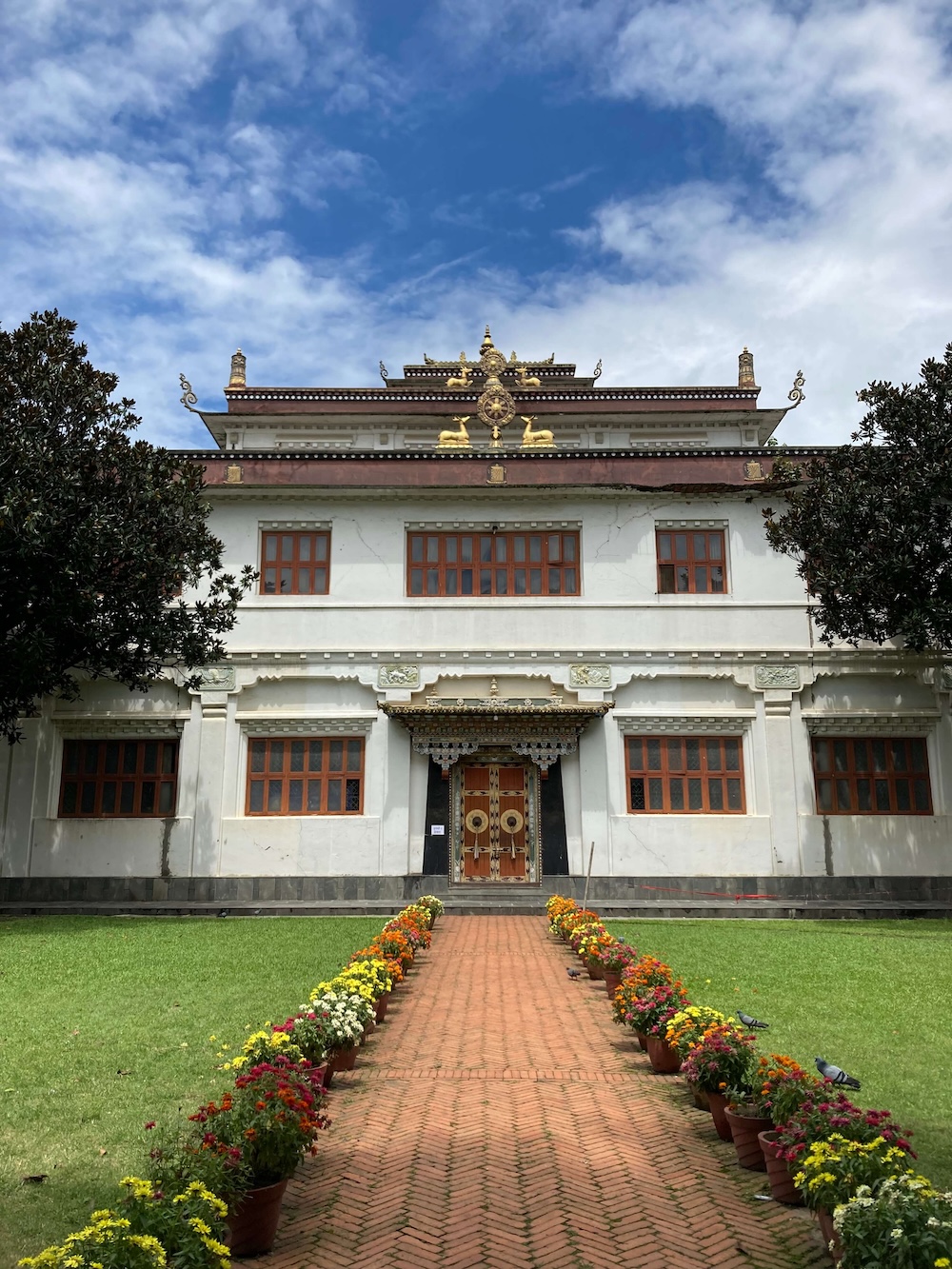
Sometimes when I meet friends, specifically Buddhist friends, they ask me, “Hey, how is it going with your studies in Nepal?… And actually, what do you do there?” I think that’s a valid question. Therefore, I will try to shed some light regarding what students at Rangjung Yeshe do and study.
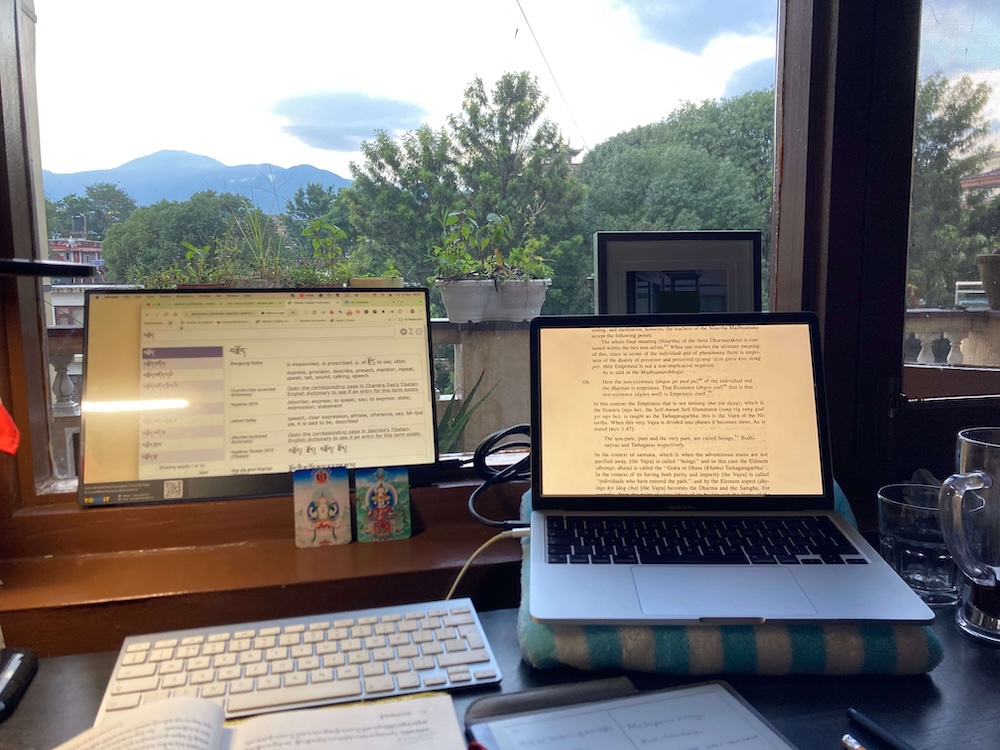
Rangjung Yeshe is unique in combining academic and traditional study styles. So when I say ‘academic,’ I mean that the institution teaches us how to write academic papers, conduct research, and understand general academic research methodology and methods. I focus mainly on philology, in a way, since, as Buddhist scholars, we have to engage with primary sources, which involves studying the source language and then the texts. Now we do indeed use other methods as well, such as hermeneutics, comparison, and so on. It is very individual who uses what for their research, but philology is a big part of it. Now, as academic students, the beauty is that we can question everything, and we learn to look at Buddhism from an outer, or etic, perspective (in contrast to the traditional, inner, emic perspective) as scientists seeking the truth. And interestingly enough, the Buddha has said himself, in the Ghanavyūhasūtra:
O monks, just as a goldsmith tests gold by rubbing, burning, and cutting before buying it, so too, you should examine my words before accepting them, and not just out of respect for me.
So, from one looking at Buddhism through the lens of academic methodologies, it fits very well with what Buddha is asking of anyone interested in his word. So these academic studies allow one to specialise in a particular field and progress in academia with an MA or a PhD. So if one has an interest in, let’s say, researching the 8th Karmapa’s Mahamudra approach or Je Tsongkapa’s lamrim teachings, one will learn the means to undertake this in a very scientific way.
On the other hand, the traditional aspect of Rangjung Yeshe that I mentioned above, we have philosophy classes, officially called “specialised textual studies,” which are taught just as in the shedra (the monastic Tibetan Buddhist school). We have khenpo or lopon teaching texts that are usually also taught in the shedras, for example, Bodhisattvacaryāvatāra, an 8th-century Mahāyāna text by Śāntideva on how to train as a Bodhisattva. This text is always taught in the first year for students who start at RYI. Then, if, let’s say, one is a BA student studying for 4 years, the following 3 years will normally rotate through 3 different texts, each with a very specific topic and goal. The first year, which is the Bodhisattvacaryāvatāra text, sets the motivation for our studies by strongly grounding oneself in the view of the awakened mind, bodhicitta. Then one of the three other texts would be The Gateway to Knowledge (Wyl. mkhyen ‘jug) by Mipham Rinpoche, a 19th-century Rime master, on the topic of Abhidharma. Then another text would focus on Madhyamaka, and finally another text would focus on Yogācāra, such as e.g. Uttaratantraśāstra. So, mainly, these texts are classical Indian Buddhist texts studied in the monastic schools of Tibetan Buddhism and form the education for monks (of course, the texts vary from school to school). And these texts are taught to us, the students, in Tibetan by the monks themselves, with an interpreter.
Therefore, at RYI, we, as students, are not only focused on the academic approach, which I would say could be very dry and, in the end, might not necessarily be enjoyed by those who are Buddhist.
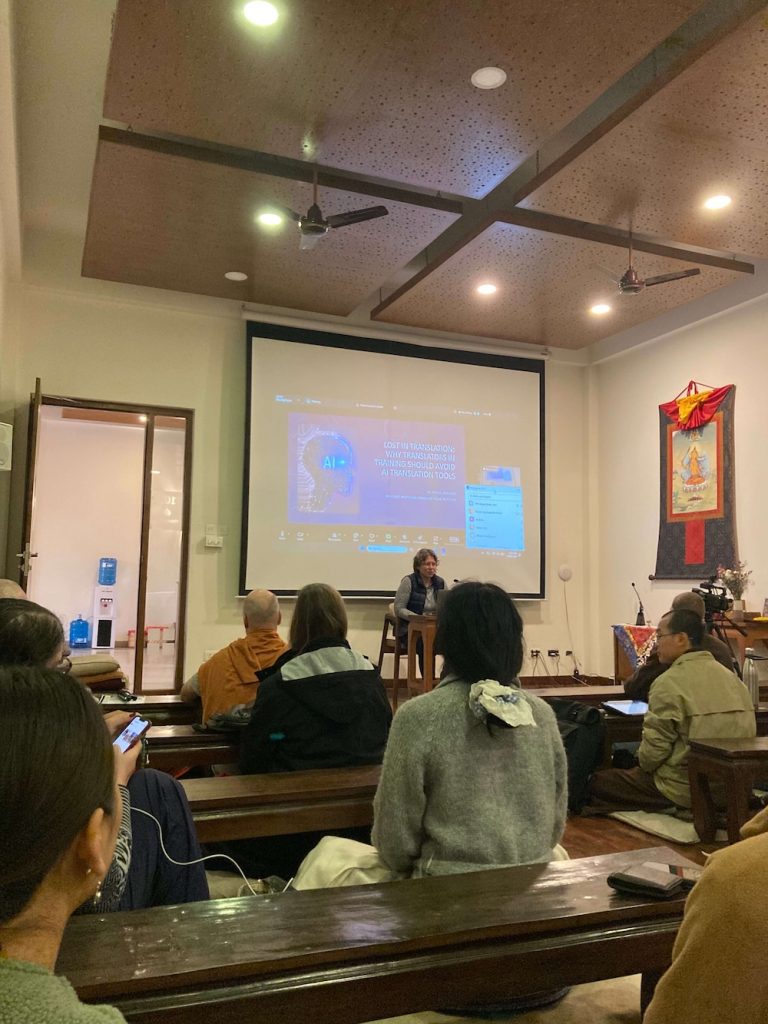
At Rangjung Yeshe, the focus is entirely on Buddhism. In the West, the study of Buddhism in universities is usually a secondary topic, falling under religious studies, theology, philosophy, and so on. So it is not necessarily a discipline in itself as we have it at RYI, and therefore, one has to study Buddhism there alongside many other topics.
The areas of study, on a BA level, at Rangjung Yeshe are as follows (please check the official page for the BA and the course catalogue there):
- Specialised Textual Studies
- Buddhist Philosophy and Hermeneutics
- Buddhist Philosophical Discourse
- Critical Studies in Buddhist Doctrine
- Fundamentals of Buddhist Philosophy
- Buddhist Scripture
- Buddhist Meditation Practices
- Methodology of Buddhist Studies
- Buddhist Ethics
- Yogācāra Thought
- Madhyamaka Thought
- Buddhist Philosophy in the Indian Philosophical Context
- Buddha Nature Thought
- Buddhist Epistemology
- Historical and Cultural Studies in Religion (it’s all about Buddhism)
- Buddhist Traditions: History and Culture
- Anthropological Study of Nepalese Religions
- Introduction to Tibetan Buddhism
- Tibetan Culture in Tibet and Nepal
- Buddhism in the Kathmandu Valley
- Buddhism and Development
- Buddhism and Psychology
- Buddhism and Science
- Buddhist Art
- Buddhist Ritual
- Himalayan Languages
- Nepali
- Sanskrit
- Classical Tibetan
- Colloquial Tibetan
- Academic English
- Buddhist Literary Chinese
- Pāli
- Nepal Bhasa
A Buddhist friend asked me, “Do you actually practice?” This is a fair question, and it usually refers to the formal practice, e.g., sitting on the cushion. The programme at RYI is very intensive. There are a lot of essays to submit, group work, quizzes, presentations, independent translations, class translations, midterms, and finals. Missing a class is usually something substantial. So yes, one can very well be taken by the flow of homeworks and so on and forget the practice. Yet, apart from the informal practice we are supposed to uphold throughout the day, which we are always reminded of, especially in the khenpo/lopon classes at RYI, there are plenty of opportunities and facilities for formal practice. Every day, a morning Puja starts around 5am, and everyone can attend and do their personal practice on the side. Moreover, we used to have a one-hour dedicated session for personal practice at the Old Lhakhang from 7 to 8am. Then, on Friday afternoon, RYI organises a guided śamatha and vipassanā session led by one of our monks. Then, on Tuesdays, whoever would like to practice chöd can join a group that meets on campus in one of our classrooms. Furthermore, free classrooms are available for personal practice, and there are many drubchens ( a form of intensive group practice specially prominent in the Nyingma tradition) throughout the semester, allowing people to participate in group practice. Also, once a year, from mid-December until mid-January, there is the annual Ngöndro and Tsawa Sum (tree roots) retreat. The ngöndro that is taught here is the Tukdrup Barché Künsel Ngöndro. So there is actually a lot of opportunity for practice, but in the end, it depends on the person’s dedication. Also, we start our khenpo/lopon classes by setting the correct motivation, then proceed to the main part, and finally dedicate all the good we have accumulated or experienced, which makes the class session itself a practice.
At RYI, students come from many countries, including many exchange students from the US and elsewhere. Those who study here represent various lineages and teachers. We have students from all five Tibetan Buddhist lineages as well as from Vietnam, China, and other places.
At Rangjung Yeshe Institute, we study Buddhist topics in depth, discussing concepts such as no-self, emptiness, and Buddha-nature. We learn about the historical development of Buddhism and the societies where it flourished and spread. We also learn basic Buddhist principles, and because Buddhism is really about the mind, we study it extensively. In my opinion, Buddhism is not a religion. It is a pity and a good feeling that people, when they hear “Buddhism,” immediately associate it with peace, vegetarianism, serenity, and so on. While these aspects exist in the tradition, they do not define it. The Buddha’s teachings are about realising the inherent nature of oneself and phenomena. It is about moving our attention from the apparent nature of what we perceive to the hidden nature of how things actually are.
So, if one would like to be like the goldsmith mentioned above, one is strongly encouraged to approach Buddhism from both academic and traditional perspectives, as we do at Rangjung Yeshe Institute. If one already has a BA or is planning to pursue one, I would strongly recommend, if one has the financial means, that one pursue either the BA or the MA at RYI and combine it with academic studies of Buddhism at a European / American / Japanese university. In this way, one will have the experience from both worlds.
To find more about the undergraduate and graduate courses, please visit the official website
Good luck!