
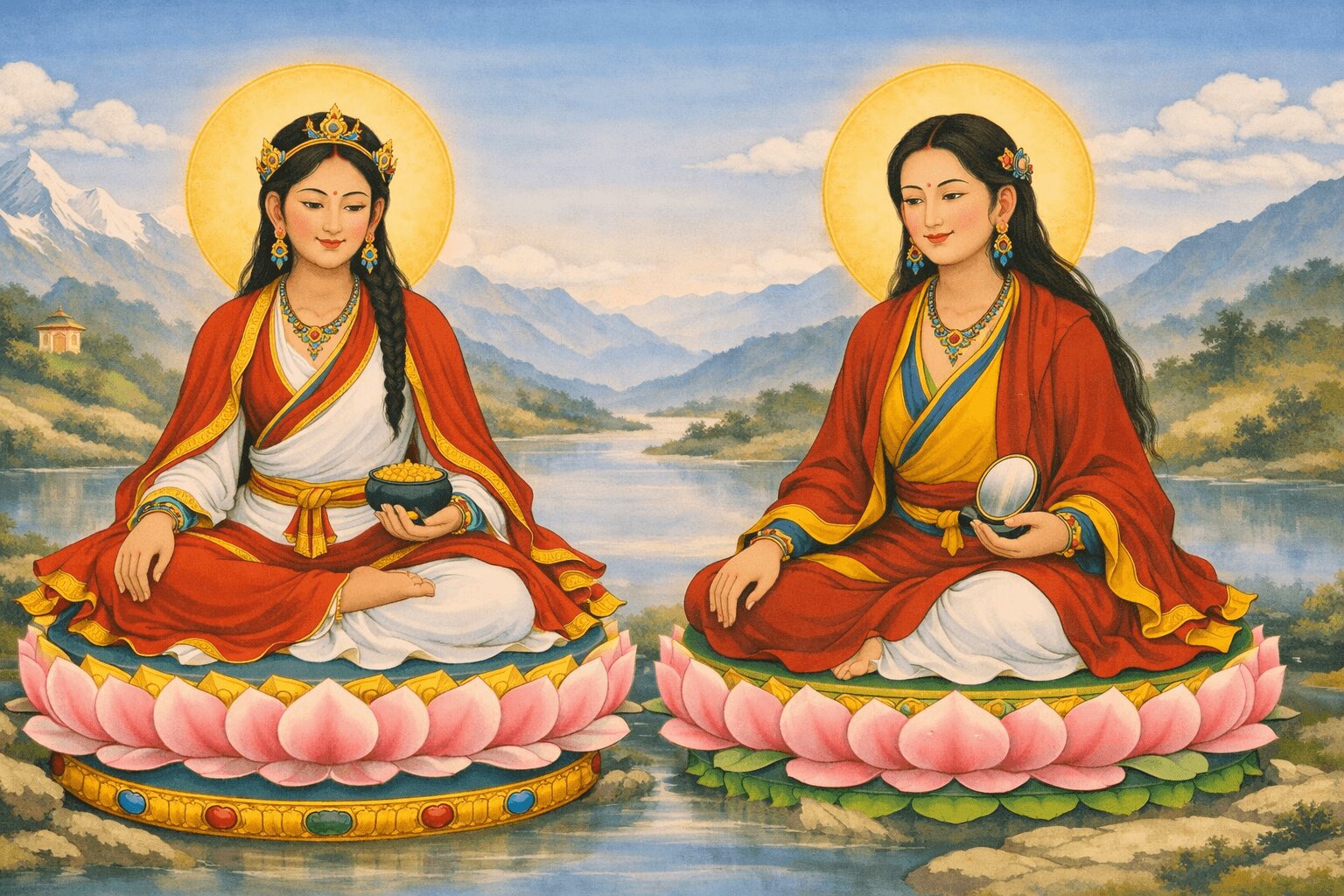
Dakmema and Nyangtsa Kargyen as ḍākinī-like figures. AI-generated representation.
Hagiographies and biographies of Vajrayana masters typically focus on the master’s spiritual development and their relationship with their teachers. Most scholarship and hermeneutical interpretations emphasize the teacher as the primary influence on the student’s spiritual growth. These works highlight the teacher-student relationship, devotion, diligence, and renunciation as the most essential to soteriological practice in Vajrayana Buddhism. However, these narratives also include, often implicitly or as a secondary element, the role of the mother figure in the future master’s spiritual progress. A notable example is the story of the great sage Milarepa (Wyl. Mi la ras pa) and his spiritual progress under the guidance of Marpa (Wyl. Mar pa chos kyi blo gros), as recounted in the hagiography by Tsangnyön Heruka (Wyl. Gtsang smyon he ru ka). Although both mothers in Milarepa’s life – his biological mother, Nyangtsa Kargyen (Wyl. Myang rtsa dkar rgyan), and his spiritual mother, Dakmema (Wyl. Bdag med ma) – feature in the narrative, their soteriological roles have not been comprehensively analyzed as essential catalysts for Milarepa’s path to awakening. Instead, scholarship consistently ignores their crucial function in the narrative and emphasises the teacher-student relationship as the sole catalyst for the practitioner’s liberation. This paper argues that the two mother figures in The Life of Milarepa are not peripheral or secondary characters, instead, they play a structurally essential role as catalysts, whose narrative function allows Milarepa to attain awakening.
Methodology
This paper’s original methodology was intended to be Buddhist and Feminist Hermeneutics, but now it has been refined and utilizes specifically two methods – narratological analysis of the spiritual biography (Wyl. rnam thar) genre, as well as Rita Gross’s feminist hermeneutics. The narratological analysis will help reposition the role that the two mothers have in the spiritual awakening of Milarepa from being seen as helpers to seeing them as guardians and teachers in their own right. For this, the paper looks at the two women individually and will analyse two aspects: 1) Their position in the narrative in terms of sequence and how this affects the development of the plot. 2) Their mundane and spiritual character function – their structural role in the story and how they contribute to the spiritual development of the protagonist. Finally, we will look at narrative economy – analysing the dream of Dakmema in the story as encoding the central function of the two mothers in the awakening of Milarepa. Feminist hermeneutics, on the other hand, will contribute to reading the story through the lens of women’s experiences, thus challenging the androcentric (male-centered) bias and reconstructing women’s agency within Buddhist texts. Feminist hermeneutics is the interpretation of a text in the interest of women in order to uncover patriarchal assumptions that assume women’s secondary status, reclaim positive historical and liberating roles that have been suppressed in the traditional narratives, and retell and reimagine those stories from women’s perspectives to empower them and restore their agency within the tradition (Gross 1993, 17-20). To do so, the paper will use Gross’s two-movement approach of textual criticism and reconstruction – the paper will use her quadruple androcentrism framework to uncover the male-centered focus of the narrative and then reconstruct the position of the two women by reassessing their contribution to the story.
The etymology of rnam thar
Rnam thar (Wyl.;) literally means “complete liberation.” Complete liberation in terms of a soteriological perspective. However, it is better known as spiritual biography, hagiography, or biography, since its general purpose is to provide a detailed account of the life events of a Buddhist saint (Rheingans 2017, 58). Even though it is tempting to see a rnam thar as historical information, it has three main purposes, and thus the text may not reflect exactly what happened from a historical point of view. Rheingans mentions that a rnam thar could be divided into three levels: outer, inner and secret, which could be understood as historical, inspirational, and instructional (Rheingans 2017, 57-60). Since this text was written about four centuries after Milarepa’s life, its function should be seen as mainly inspirational and instructional, and less so as historical.
Nyangtsa Kargyen – Opening Movement
Nyangtsa Kargyen, Milarepa’s biological mother, occupies the opening movement of the story, establishing the soteriological conditions for Milarepa. Her character in the narrative has two functions – mundane and spiritual. From the mundane side, she can easily be cast as the bad mother who sends her son to study black magic that claims many lives. This perspective, however, ignores the position in which she finds herself, as a woman, after the death of her husband, a single mother of two children in a heavily patriarchal setting, with all the wealth of their family given to the brother of his husband and his wife. Furthermore, it also overlooks her spiritual role in Milarepa’s awakening. Therefore, to understand both of these character functions, we must examine her actions and motivations in the narrative through the lenses of historical facts and mundane perceptions, as well as of spiritual liberation. In a spiritual biography, every action and intention of the people involved must be viewed in terms of how they contribute to the path of liberation. Nyangtsa Kargyen is said to have been from a prominent family, and the text mentions that “She was skilled in tending to worldly affairs, clearly loathing her enemies and loving her friends,” traits of a personal character that are not alien to most people (Quintman 2010, 44). After a few years of enjoying wealth and fame, however, Milarepa’s father passes away, and their lives change, leaving the mother and her children completely dependent on the uncle and aunt. This initiates tremendous suffering (Quintman 2010, 47). Here is where the mundane function becomes clear – even though Nyangtsa Kargyen has become a single parent while also being the target of constant gossip from those around her, she manages to show love and compassion towards both children, keeping them safe (Quintman 2010, 47). From this point onwards, her suffering becomes the source for growing compassion and renunciation in the character of Milarepa, which are the essential causes for him seeking the path later – her spiritual function. This mixture of compassion and suffering culminates in Milarepa attending to the wishes of his mother by studying black magic and then casting spells that kill many people. This leads Milarepa to accumulate negative deeds. From the spiritual-liberation point of view, this led him to reflect on the defects of all worldly concerns and to reach a state of renunciation and dissatisfaction that brought him to the next two main characters in the story, Dakmema and Marpa (Quintman 2010, 127). Thus, Nyangtsa Kargyen shows us that she is not only a single parent, a woman who has brought up two children with love and kindness, but also the catalyst for compassion and, especially, renunciation in Milarepa, which led him to Dakmema.
Dakmema – Central Movement
Dakmema occupies the central movement, sustaining the soteriological conditions which Nyangtsa Kargyen has developed for Milarepa. Her appearance in the narrative, however, is alongside Marpa, and thus her unique contribution to Milarepa’s development feels obscured. However, her character function in the narrative, like Nyangtsa Kargyen’s, is not secondary. Unfortunately, this view can be further solidified when we look at the Tibetan and see how both Dakmema and Milarepa use honorific speech when communicating with Marpa. When Marpa communicates with both of them, he uses derogatory commands or imperatives, thus indicating a higher status on the hierarchy ladder in the narrative (Pickens 2019, 313). Yet, seeing Dakmema’s role as supporting the main role of Marpa in the narrative is male-centered and it does not acknowledge the two functions that she has in the narrative. In her mundane character function, Dakmema, like Nyangtsa Kargyen, is caring and loving, allowing Milarepa to navigate the hardships Marpa has imposed1. Moreover, she also takes care of Marpa, sharing her kindness and wisdom with him, making him more mild and compassionate2. On the other hand, her spiritual function also manifests in her kindness and compassion when she takes care of Milarepa every time Marpa scolds him, allowing him to stay focused on the goal and to develop compassion, particularly devotion and openness towards Marpa. She always tries new ways for Milarepa to obtain the teachings from Marpa and makes sure that he does not form a wrong view about him3. Thus, Dakmema shows us that she cares for Milarepa on a mundane level, helping to ease his suffering under Marpa. And at the level of spiritual liberation, she further develops his compassion and openness towards Marpa, allowing Milarepa to become a genuine student. Therefore, she takes a central role, a role of guardian for both Milarepa and Marpa.
The Dream of Dakmema – Narrative Economy
To support the view that both women in the narrative are as important to Milarepa’s awakening as Marpa, we will look at the dream of Dakmema, which we find in the story alongside Marpa’s dream, just before Milarepa meets them for the first time. In there, Dakmema states that there were two women, from Oḍḍiyāna, who carried a crystal stupa:
O lama, last night I dreamt that two women, who said they were from Oḍḍiyāna in the north, appeared carrying a crystal stupa, slightly soiled on the outside. They said, ‘It is lama Nāropa’s command to master Marpa that the master consecrate this stupa and place it on the summit of a mountain.’ You, master, replied, ‘Paṇchen Nāropa has already consecrated this stupa, but I must obey his command.’ You then performed extensive consecration rites, washing the stupa with water from the vase and so forth. You then placed it on a mountaintop where it radiated light as dazzling as the sun and moon and replicated numerous copies of itself on the tops of neighbouring mountains. The two women served as stewards for them all (Quintman 2010, 67)
I could not find any scholarship that has examined this relationship, but following the principle of narrative economy, that in a purposefully structured hagiography, no element is without function, suggests that Dakmema’s dream is not incidental but structurally motivated, encoding within the narrative itself the soteriological roles of Nyangtsa Kargyen and Dakmema. The “slightly soiled on the outside” crystal stupa represents Milarepa himself, soiled by the negative deeds he committed. Both of these women brought the stupa to Marpa so he could purify it. And they served as stewards to them all, showing that these women not only cared for Milarepa but also for Marpa himself.
Androcentrism and Dependent Origination
Now, as we saw in the previous sections, if we think of these two women doing some sort of support or secondary work who allow the man, Marpa, to perform the main part of the work, then from a Buddhist perspective, we are ignoring the basic idea of dependent origination and from a feminist perspective, this view falls under androcentrism. Gross speaks of quadruple androcentrism – recording, tradition, scholarship, and the contemporary level4 and of these four possibilities, if we see the role of these two women in the narrative as supportive rather than essential, then three out of them are automatically present (Gross 1993, 18). The first one is Tsangnyön Heruka’s narrative itself, despite encoding the women’s importance, frames Marpa as the central figure. Then the mothers appear in the text, but scholarship ignores them in favor of Marpa. Finally, Western Buddhist Studies scholarship reproduces that androcentric focus on the teacher-student relationship. Therefore, using dependent origination and understanding androcentrism allows us to establish the role of Nyangtsa Kargyen and Dakmema in the narrative as co-constitutive together with that of Marpa, thereby empowering women rather than disempowering them (Gross 1993, 20). Moreover, since this is a spiritual biography that is mainly inspirational and instructional in nature, it provides a balanced understanding for both men and women of how important each sex is on the path.
Conclusion
The dream example that Dakmema recounts encodes the argument this paper makes within the narrative. The two women from Oḍḍiyāna – the tantric realm of ḍākinīs – who bring the crystal stupa to Marpa match the two mothers in the narrative perfectly. They bring Milarepa to Marpa, so he can do the final purification and final step for Milarepa’s awakening to manifest. However, this dream example, even though encoded within the story itself, has somehow slipped from the scholars’ sight, reinforcing the androcentric reading that Gross’s feminist framework helps us identify and correct. Yet, by bringing this forward, we understand that Milarepa’s spiritual development and awakening are not Marpa’s domain alone. It is actually within the domain of Nyangtsa Kargyen, Dakmema, and Marpa. In other words, it resembles dependent origination in the sense that without the three qualities of renunciation, compassion, and openness that the two women brought forth in Milarepa, he would not be able to become a suitable student for Marpa; likewise, without Dakmema’s tempering influence on Marpa, he could not have become the teacher of Milarepa needed. Thus, Milarepa’s awakening depends entirely on these three characters.
Footnotes
- With that I laid the foundations for a covered walk and began construction. All the while, the lama’s wife provided me with wellseasoned food and enough beer to keep me slightly drunk. Like that she comforted me and showed me great affection (Quintman 2010, 75) ↩︎
- I know now that you are insufferable since you have assigned such pointless work on these towers. Be compassionate and grant Great Magician the dharma (…) Your power has blinded you to the truth. Not only does he have a sore, his back is festering with sores. (Quintman 2010, 72) ↩︎
- The lama declares, ‘The dharma teachings I carried back from India were brought for the benefit of beings.’ Were even a dog to appear before him, he would teach it dharma and then dedicate the merit of having done so. I don’t know why he won’t accept you. But in any case, don’t form wrong ideas about him (…) The lama’s wife said, “Now son, you should by all means receive the initiation.” She gave me a ball of butter wrapped in leather, a bolt of woolen cloth, and a small copper kettle. I presented them as offerings and then sat down in line for the initiation (Quintman 2010, 75) ↩︎
- The recording level – when Buddhists chose which documents to keep and whose experience to preserve in their historical records, they usually operated with an androcentric consciousness and set of values. 2) The tradition level – even when Buddhists did preserve significant records by or about women, later Buddhist traditions tend to ignore those stories in favor of stories about male heroes. 3) The scholarship level – most Western scholarship on Buddhism is quite androcentric and often agrees with the biases of Buddhist records, to the point of further ignoring the few records about women or even ridiculing the women in them. 4)
The contemporary level – Finally, not only are the Buddhist past and Western scholarship on Buddhism thoroughly androcentric; contemporary Buddhism itself, both Asian and Western, is unrelenting in its ongoing androcentric
↩︎
References
“Milarepa.” n.d. The Treasury of Lives. https://treasuryoflives.org/biographies/view/Milarepa/P1853.
Gross, Rita M. 1993. Buddhism after Patriarchy: A Feminist History, Analysis, and Reconstruction of Buddhism. With American Council of Learned Societies. State University of New York Press.
Pickens, John. 2019. “Marpa’s Commands in the Milarepa Life Story.” Bulletin of the School of Oriental and African Studies 82 (2): 303–14. https://doi.org/10.1017/S0041977X19000375.
Quintman, Andrew. 2010. The Life of Milarepa. With Donald S. Lopez and Tsangnyön Heruka. Penguin Publishing Group.
Rheingans, Jim. 2017. The Eighth Karmapa’s Life and His Interpretation of the Great Seal: A Religious Life and Instructional Texts in Historical and Doctrinal Contexts. Hamburg Buddhist Studies 7. Projektverlag.